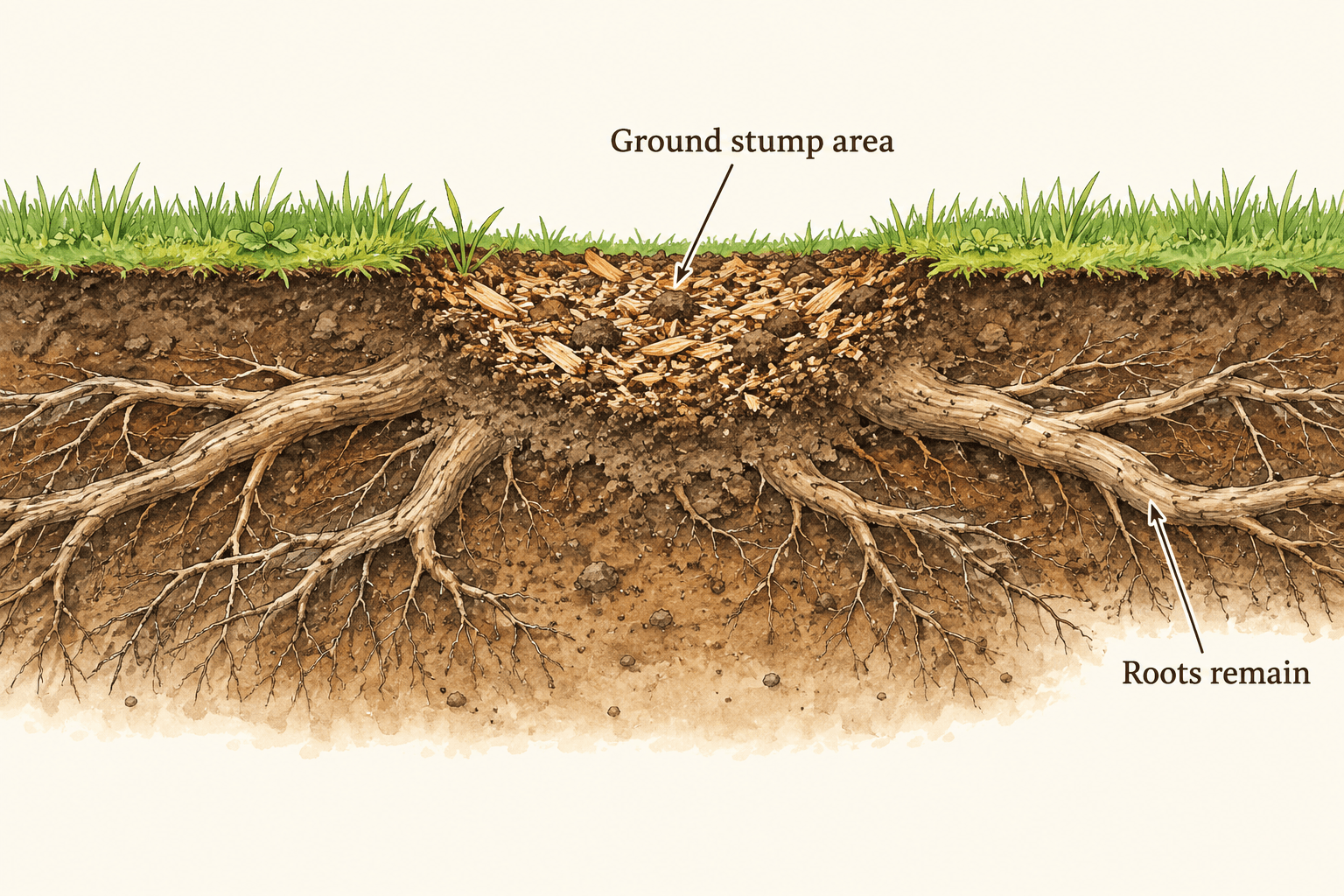
Stump grinding leaves roots outside the agreed grinding area underground. It is not whole-root excavation. Those roots can decay over time, and some species may produce new shoots, so the next use of the space matters.
Remaining roots do not all need to be removed automatically. The decision depends on whether they obstruct planting or construction, create a surface problem or belong to a tree that is being retained.
What remains below the surface?
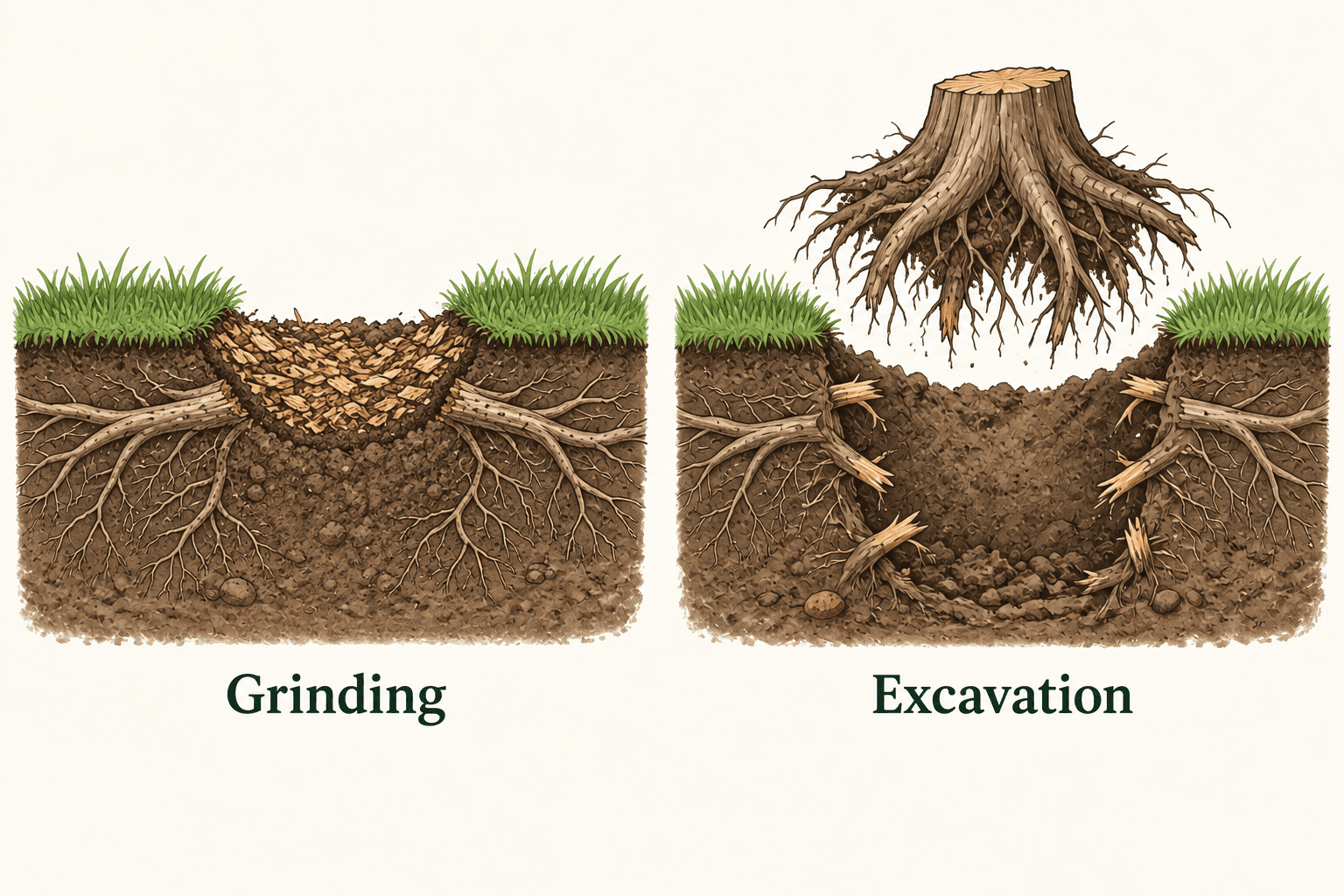
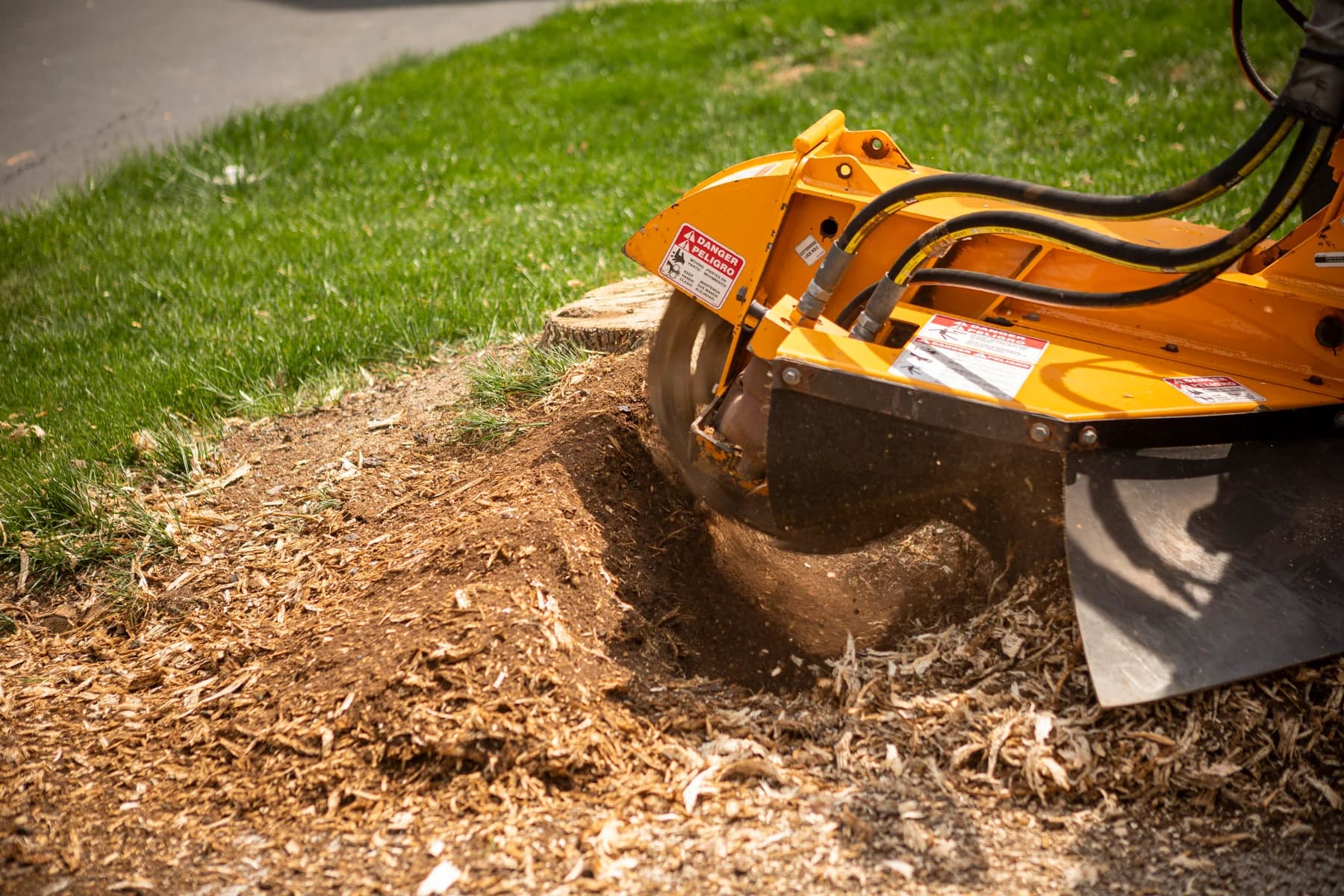
The cutting wheel works through the stump and the agreed root flare. It does not follow every lateral or deep root across the property. Even when the central stump is gone, substantial roots can remain beyond it.
The feature illustration shows this distinction schematically. It does not promise a particular grinding depth. Access, buried services, hard surfaces and the agreed scope can limit the work.
For the operation itself, see how stump grinding works.
Decay and regrowth are different processes
Buried wood breaks down at a rate influenced by species, size, soil and moisture. There is no dependable universal timeframe for every root to disappear.
Some trees can send up shoots from remaining roots or stump tissue. Grinding reduces the stump but does not guarantee that every species will stop reshooting. Identify the source of any new growth before deciding how to manage it.
Do not assume a shoot belongs to the removed tree merely because it appears nearby. Roots from neighbouring or retained trees may share the area.
Prepare the area for grass or planting
Loose grindings are not equivalent to topsoil. Excess woody material may need to be removed or redistributed before suitable soil is added. As fresh wood decomposes, mixing substantial amounts into the soil can affect nitrogen availability.
The Iowa State University Extension guide to grass after stump removal (opens in new tab) explains why soil preparation matters. Local soil and planting conditions should determine the final preparation, not a fixed overseas calendar.
For a replacement tree, consider a position away from the old stump where practical. Remaining roots, soil volume and drainage may make the original hole unsuitable.
Allow for settlement and construction requirements
Ground can settle as buried wood and loose material change. The extent is site-dependent. A level surface immediately after grinding is not a guarantee of long-term stability.
Paving, footings and building work can require removal or ground preparation beyond grinding. Have the relevant designer or contractor define that requirement. AA's stump-grinding service is not certification for construction.
If a substantial root mass must be physically lifted out, read the grinding-versus-excavation comparison and arrange the appropriate separate scope.
Avoid damaging services or retained trees
Roots near drainage, irrigation, electrical services or structures need careful investigation. Grinding a stump does not repair a damaged pipe or establish the cause of a blockage.
Use Before You Dig Australia (opens in new tab) and appropriate locating before further disturbance. Plans do not necessarily show private services or exact depths. Do not cut roots belonging to a retained tree simply because they obstruct a landscaping line; its stability and health may be affected.
The useful question is what must be removed for the intended finish, and what can safely remain—not whether every buried root can be eliminated.
Originally published .

AA Tree Services Sydney
Tree services in Sydney
Our team includes an AQF Level 3-qualified arborist with more than 15 years of tree-work experience. We provide tree removal, pruning, lopping, tall hedge trimming and stump grinding for homes, strata and commercial properties across Sydney, and write these guides from that work.
About AA Tree Services